



Originally written for an externally set brief, limited to five figures.
Executive Summary
This report finds that while there is rising concern about social issues, economic factors still best predict voting behaviour for the two major parties. Improved performance in the polls of smaller parties, such as Reform, indicates the two-party system has not sufficiently responded to these social concerns, particularly regarding immigration. This imbalance could be a future source of instability with the potential to trigger a shift to social issue oriented voting.
Three key characteristics are especially relevant in predicting social and economic divides in public opinion: age, wealth and gender. To properly contextualise these divides, we look also at voting intention and historic public opinion.
Whether or not Britons prioritise social over economic issues significantly depends on age, and secondarily on gender. Young people are more likely to position themselves strongly to the left on social issues, with the elderly generally holding right-leaning economic views. There is movement to the right on both topics with age. Women have larger differences in social views between generations when compared with men, moving from strong social progressivism amongst the young to social conservatism amongst the elderly.
Wealth predicts a desire for increased focus on social issues, but only amongst those in their mid-career; age here is the more determinate factor.
Certain highly divisive social topics, including transgender rights and drug legalisation, fail to have a significant influence on voting behaviour, possibly due to a lack of adoption by political parties.
Data from this briefing is sourced from a representative sample of the UK population (Non-public source, n=10,005). Full questions and methodology are attached.
Determining the significance of different issues to the public is a challenge; solely asking respondents about their primary concerns might overlook secondary issues and fail to assess intensity of conviction. In our poll, we asked respondents to place themselves on a spectrum between two perspectives regarding different political topics. Certain conceptual issues arise when attempting to split issues into social and economic groups, but this remains a valuable categorisation in understanding existing divides.
We begin by conducting a preliminary investigation into public attitudes as a whole, before considering individual strata of the population.
Divisiveness as a metric for issue importance
Averaging poll response provides a good measure for the general feeling of the British electorate but is insufficient to determine issue importance. Divisiveness is a more useful measure for this purpose as it quantifies the spread of responses or strength of feeling. Both metrics need to be considered to best understand the relationship between social and economic issues.
Our analysis shows transgender rights and the impacts of immigration on British society are the most polarising social issues, each splitting the public roughly evenly. NHS funding is an economic issue that attracts equally strong feelings, but the public is more unified, with a 5% mean lean towards increasing funding over reform. Other economic issues attract less strong feelings despite little public consensus.
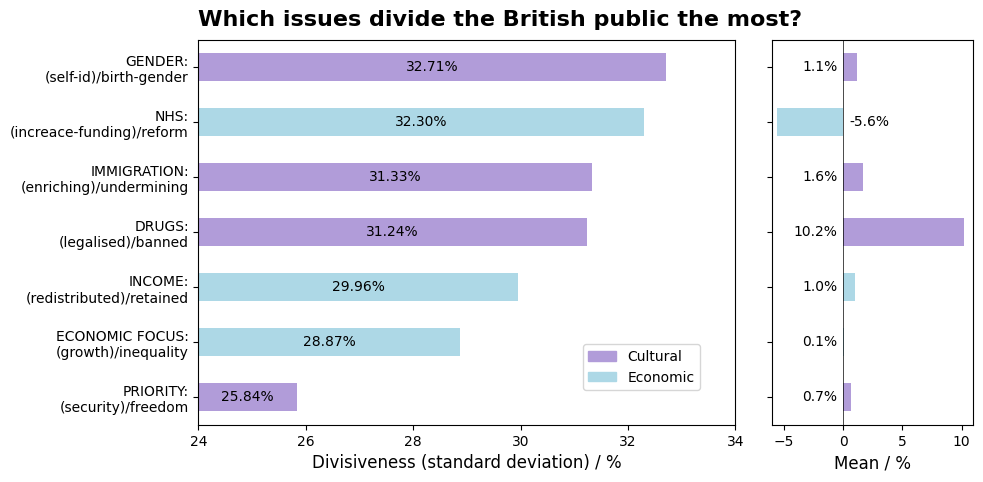
Social issues are more likely to provoke extreme perspectives than economic issues.1 Voters are hugely devoted to the NHS as an institution2 and might approach the funding debate as a question of more than just economics.
Deciding factors in voting
However, these statistics alone do not tell us how viewpoints translate into voting behaviour. By applying a statistical analysis called logistic regression, we can find the issues that best predict voting intention for different parties. These are the “deciding factors” that drive a vote for one party over another. We consider the four largest parties by current polling.3
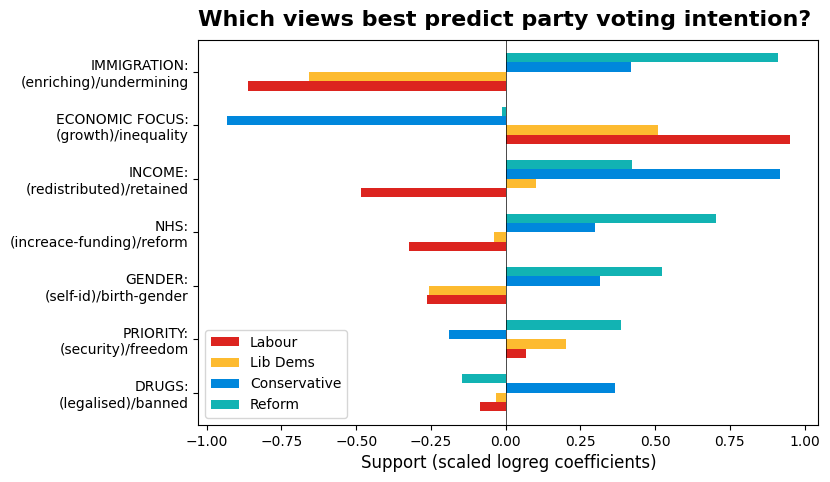
The primary predictor for Conservative and Labour voting intention remains their respective economic outlooks, the traditional differentiator between the two major parties; income tax is also a particular concern for Conservative voters. Economic perspectives are more important predictors than social views, despite being generally less divisive.
That said, views on the cultural impact of immigration are a strong predictor of ballot box behaviour for all parties. This could be because it has become a highly partisan issue, taking prime position in many manifestos, where transgender rights and drug legalisation have not.4,5 Reform’s position is of note, with voting intention strongly determined by right-leaning social perspectives. Liberal Democrats voters follow Labour on social issues but are generally moderate on the economy. Both of these smaller parties currently poll at ~10% and could prefigure the increasing salience of social issues to the public at large.
Influence of wealth
Wealth is one factor we would expect to be significant in determining attitudes towards political focus on cultural issues. Here, we have asked respondents if politicians focus too much on cultural issues, then broken down the results by age and financial health.
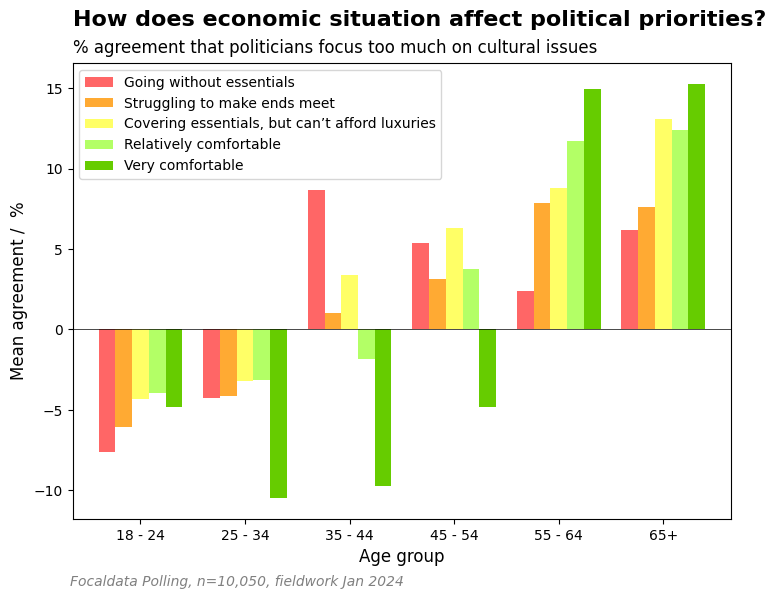
Respondents in their mid-careers are split on this issue, with those less well-off far more likely to agree that politicians focus too much on cultural issues. More strikingly, a clear generational divide emerges, with the young happy to see increased cultural focus and older voters believing these issues are already discussed too much. In our polling, age-based trends appear across social and economic issues, so understanding this relationship is crucial in explaining national voting behaviour.
Age and gender trends
As shown above, two of the most significant deciding issues for voters are economic policy and the socio-cultural impact of immigration. We take these as economic and social indicator axes, and then plot response by generation and gender.
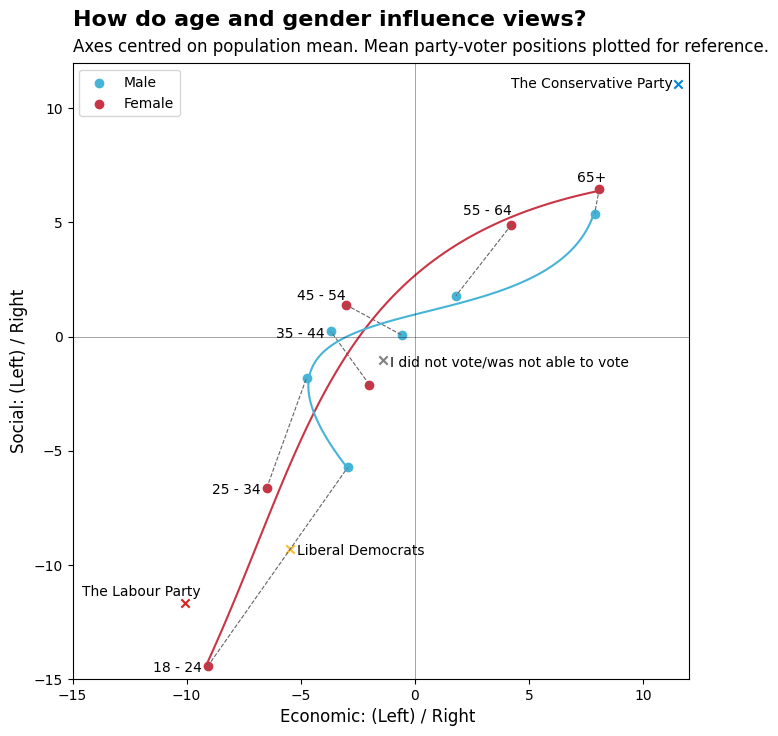
For both men and women, there is general movement right on both indicators with age; but this isn’t a linear relationship. Young women are distinguished by a strong left-wing perspective on social issues, with rapid movement to the centre through to middle age. Then, economic issues become the principal axis for further movement right. Men mirror this behaviour but start with a leftward drift on economics and stay closer to the population mean on social issues.
While we can’t assume future generations will follow the same pattern, these trendlines do suggest primacy of social issues for younger voters with economics being the more important consideration for the elderly. Recent commentary has flagged a major gap opening between the worldviews of young men and women,6 a trend also reflected in our data.
How things have changed
Looking back at the population view, we can contextualise these findings with historic public opinion to understand how we’ve reached our current position.
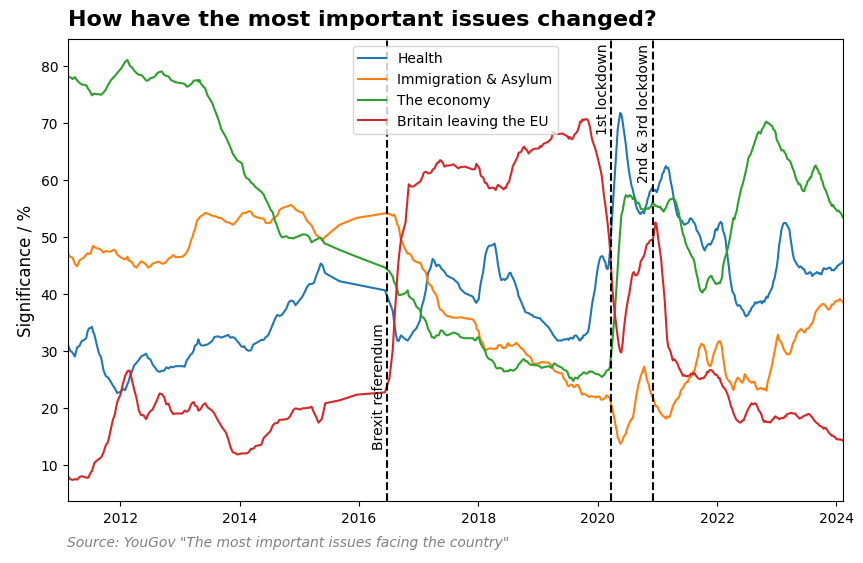
The view from the last decade can be characterised by periodic crises dominating public concern, triggered by political shocks. Economic matters had primacy at the start of the 2010s, with immigration overtaking them as the key issue following growth7 and the refugee crisis. The focus then shifted to dealing with Brexit, until the deal was ratified in early 2020. Health and economic issues quickly returned to the forefront due to the pandemic, where they remain today, though there are signs we may be entering a period of volatility.
The last few years have seen steadily increasing concern about immigration. At the 2015 general election, when it was the most important reported issue for the public, UKIP achieved 12.6% of vote share; a figure close to being matched by current Reform opinion polling. Opinion is split as to whether these high polling figures will transfer to votes.8
Conclusion
With the possibility of Conservative collapse at the upcoming election and the public most divided on social matters, a major realignment could be imminent in the British political landscape. On economic policy, the two major parties have converged in recent years,9 leaving increased room for differentiation on social issues. A new generation of voters seem likely to embrace this change
That said, economic considerations currently remain most important for voters and effectively predict support for the Conservatives and Labour. Challenging economic conditions mean that these issues are unlikely to become less significant.
Bibliography
[1] https://www.focaldata.com/blog/bi-focal-11-what-explains-our-politics
[2] https://www.ipsos.com/en-uk/what-makes-us-proud-be-british
[3] https://deltapoll.co.uk/wp-content/uploads/2024/02/Deltapoll-240226_trackers.pdf
[4] https://www.bbc.co.uk/news/uk-politics-66299705
[5] https://www.politico.eu/article/britain-labour-party-leader-keir-starmer-no-uk-drugs-reform/
[6] https://www.ft.com/content/29fd9b5c-2f35-41bf-9d4c-994db4e12998